Data Synchronization in KDE

Synchronization is one of the common problems I face with my multiple machines. This article is about how KDE help me in keeping my data synchronized across machines without any problem.

Categories: Debian-Pages Computing 

ctime, atime and mtime

ctime, atime and mtime

It is important to distinguish between a file or directory ’s change time (ctime), access time (atime), and modify time (mtime).

ctime -- In UNIX, it is not possible to tell the actual creation time of a file. The ctime–change time–is the time when changes were made to the file or directory ’s inode (owner, permissions, etc.). It is needed by the dump command to determine if the file needs to be backed up. You can view the ctime with the ls -lc command.

[Read More]
Categories: Computing Technology 

Secure P2P Sharing

First,

DISCLAIMER: I ’m not a guru, I’m just a learner. So there might be a chance that the whole article might be fundamentally wrong.

I thought of this because I use P2P network a lot.

On my laptop, which is the repository of everything I have, it is necessary for me to make sure that it is secure enough.

To firewall it I use the single rule from iptables:

[Read More]

MacInDell

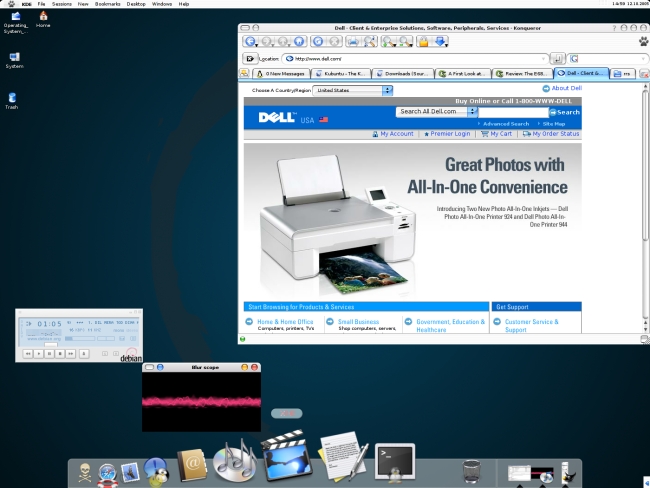
Just how would it look if Mac were to come with Dell laptops.

The screenshot might give some picture.

Categories: Debian-Pages Fun Computing 

New SSH Session in Konsole

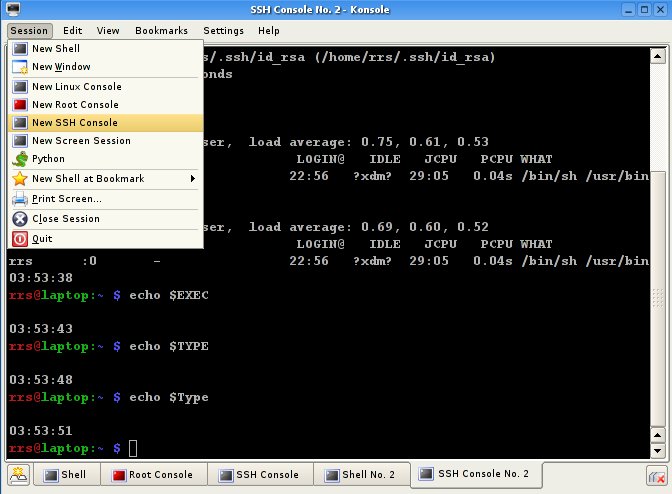
Some quick steps to create an Option for “New SSH Session” under Konsole which includes keychain and ssh-agent for password-less ssh logins.

I’m using a Debian system but majority of the steps should be common across all distributions.

  1. Install keychain and openssl-client programs (ssh-agent is part of openssl- client package under Debian)
    rrs@laptop:~ $ apt-get install keychain openssl-client

  2. Add the following lines to your .bashrc file

    For SSH

    For now I’m gambling the linux session for ssh-agent.

    I’ll have to find a better way in the future. 30/09/2005

    if [ $TERM == linux ]; then

    [Read More]
Categories: Tools Computing 

POP3 SSL && Fetchmail

Small HOWTO on configuring POP3 SSL with Fetchmail.
Here I assume that the server’s SSL certificate is a Self Signed Certificate

  1. openssl s_client -connect mail.logicalwebhost.com:995 -showcerts
    Execute this command to fetch the details of the server and also the certificate.
    The output will be something like below:

rrs@laptop:~ $ openssl s_client -connect mail.someserver.com:995 -showcerts
CONNECTED
depth=0 /C=US/ST=CA/L=San Jose/O=Some Internet Hosting Services/OU =Automatically-generated POP3 SSL key/CN=mail.somehost.com/emailAddress=postmaster@researchut.com
verify error:num=18:self signed certificate
verify return:1
depth=0 /C=US/ST=CA/L=San Jose/O=Some Internet Hosting Services/OU =Automatically-generated POP3 SSL key/CN=mail.somehost.com/emailAddress=postmaster@researchut.com
verify return:1

Certificate chain 0 s:/C=US/ST=CA/L=San Jose/O=Some Internet Hosting Services/OU=Automatically-generated POP3 SSL key/CN=mail.somehost.com/emailAddress=postmaster@researchut.com i:/C=US/ST=CA/L=San Jose/O=Some Internet Hosting Services/OU=Automatically- generated POP3 SSL key/CN=mail.somehost.com/emailAddress=postmaster@researchut.com

[Read More]
Categories: Tools Computing 

Open Source Is SHIT

Yes, that’s rightly mentioned in the title. I’m not a fucking good speaker but this link might be good enough for explanations on why ESR and his open source fundas are shit.

Follow the facts, not the hype.

Free Software has always been about user rights and RMS has done great job.
For me personally, it’s been FSF because of which today what I am. Being a dumb chap from a rural town in a rural state of India and born in a complete business family, I had never dreamt of becoming a computer professional anyway. It was FSF and RMS’ idealisms that brought me today to where I am.

[Read More]
Categories: Rant Computing 

Why Debian

The following talk is all about Debian for which I was made to speak at the ILUGD meet held on the 18th of April 2004. Most of the references in this talk has been taken from Manoj Srivastava’s (Lead Debian Developer) talk.

/* Begins

Debian OpenLogo

Why Debian

Debian – Philosophy, Merits and Key Features

Philosophy ** **

Philosophy is the most durable differentiating criterion between the operating systems we are considering. Performance numbers change. Ease of use, reliability, availability of software – all these characteristics change over time, and you have to go out and re-evaluate them over time.

[Read More]
Categories: Debian-Pages Computing  Tags: debian ILUGD Talks